
What’s your knee’s
score today?
A strength dynamometer and a force plate measure how much force each leg produces, how high and how fast you jump. Then you get a report you can read, telling you what to train next.
We only do strength training. Reports are in Chinese. Your coach goes through yours with you in basic English.
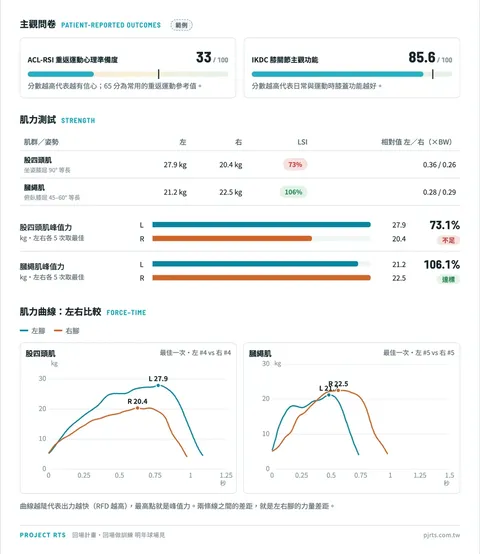
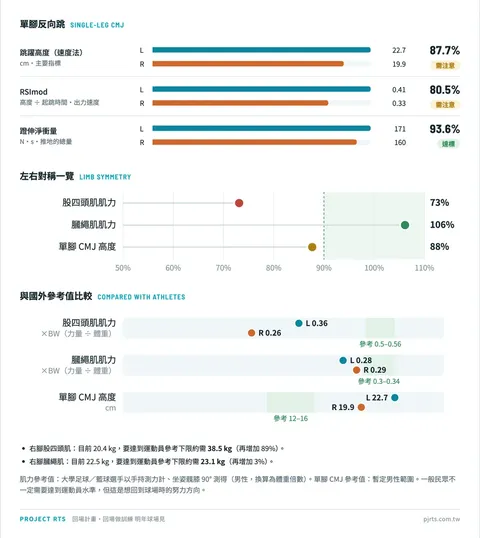
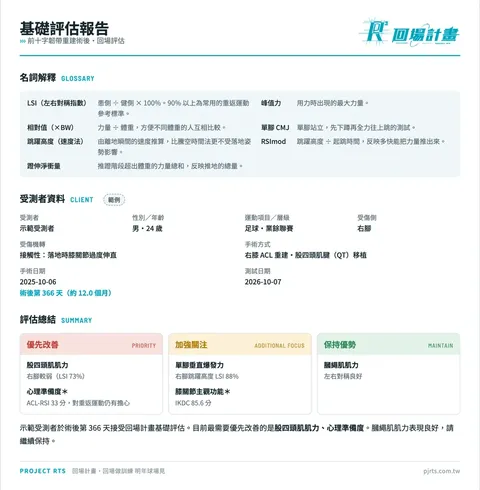
Feelings can fool you. Numbers don’t.
Your knees need testing too
Many people get a medical exam every year. Did you know your knees need testing too?
How different your two legs are, whether you jump high enough: you can’t feel it day to day. Feeling fine doesn’t mean you’re strong enough.
Injured or not
You had surgery or an injury and want to know how much you’ve got back. Or no injury, but you want to run faster and jump higher, or you’re getting older and want to know if your knees are still strong enough.
About 30 minutes, then your report
Two questionnaires → strength test → jump test → your report. The basic assessment takes about 30 minutes and gives you a 3–5 page report that tells you what to train first.
Test every few months after surgery, and see your progress
Time passing doesn’t mean your ability is there. After surgery, it’s best to test at each of these points. Without surgery, test again 3 months after your first test.
Post-surgery tracking pack: an advanced assessment at months 4, 6 and 9, 3 assessments for NT$9,999 (regular NT$11,997). Retest within 3 months: basic NT$1,999, advanced NT$3,299.
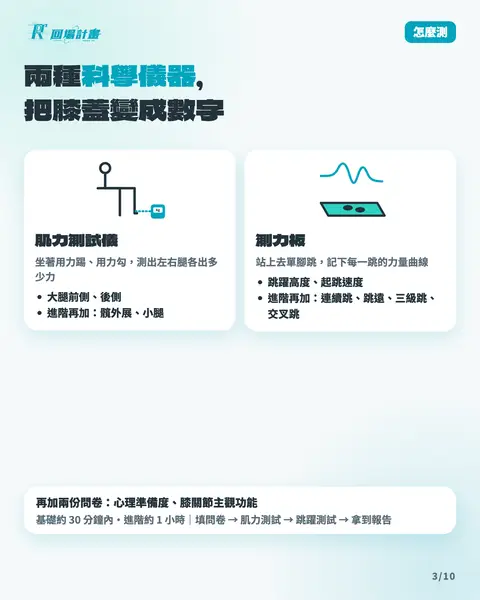
Two scientific instruments turn your knee into numbers
Strength dynamometer
You sit and kick or pull as hard as you can; it measures the force from each leg.
- Front and back of the thigh
- Advanced adds: hip abduction, calf
Force plate
You stand on it and hop on one leg; it records the force curve of every jump.
- Jump height, take-off speed
- Advanced adds: repeated hops, broad jump, triple hop, crossover hop
Two questionnaires
Readiness to return, and how your knee feels and works
Strength test
Left and right, front and back
Jump test
Height, speed, force curves
Your report
Three-color summary + strength training suggestions
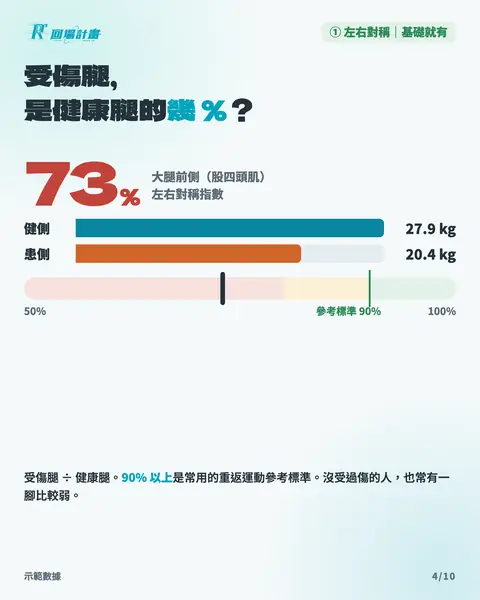
Every chart, easy to read
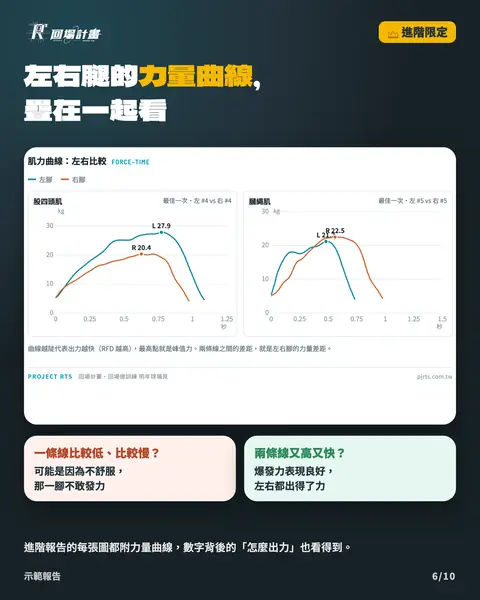
Your left and right force curves are laid over each other, so you can see whether you’re holding back or have the power. (Sample numbers. Reports are in Chinese.)
Testing only, or your first session?
| Testing only | Better value First session | |
|---|---|---|
| Time | About 30 min | 60 min |
| Price | NT$2,500 | NT$2,200 |
| Basic strength & power assessment | ✓ | ✓ Free |
| Report | ✓ | ✓ |
| One-on-one coaching | — | ✓ |
First session NT$2,200: a coach takes you through the movements one-on-one, and the basic strength & power assessment is included free.
If you only want testing, you can book it on its own (about 30 minutes, NT$2,500). Just tell us on LINE.
Basic vs advanced, in one table
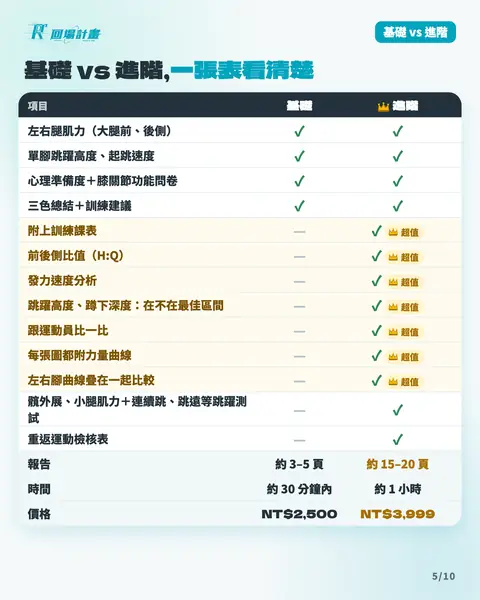
| Item | Basic | Advanced |
|---|---|---|
| Leg strength, left and right (front and back of the thigh) | ✓ | ✓ |
| Single-leg jump height and take-off speed | ✓ | ✓ |
| Two questionnaires + three-color summary + strength training suggestions | ✓ | ✓ |
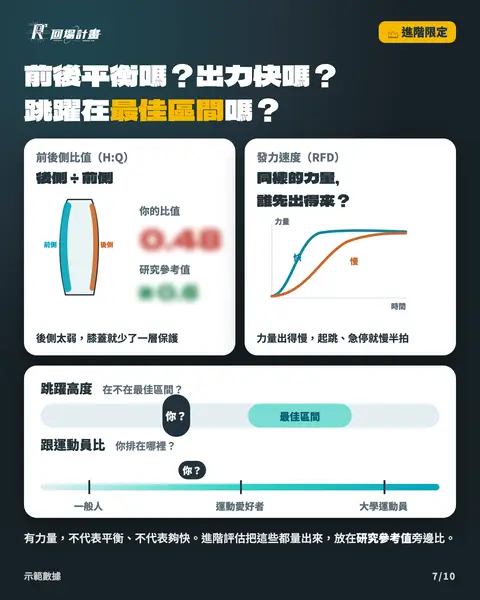
| Hamstring-to-quadriceps ratio (H:Q), rate of force development | — | ✓ |
| Whether your jump height and squat depth are in the best range | — | ✓ |
| Comparison with athletes; a force curve on every chart | — | ✓ |
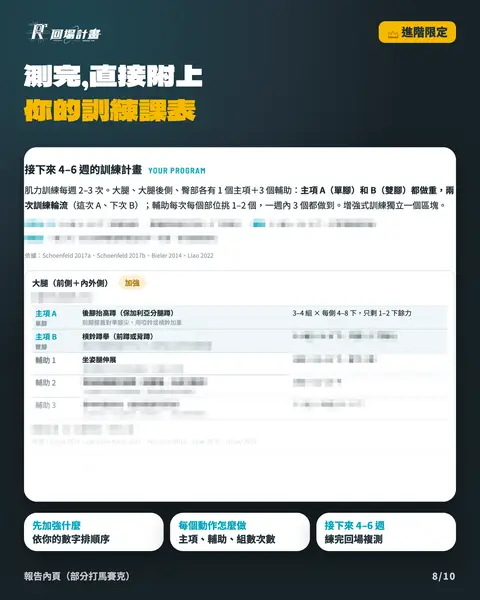
| Strength training plan and return-to-sport checklist | — | ✓ |
| Time | Under 30 min | About 1 hour |
| Report | 3–5 pages | 15–20 pages |
About 30 minutes; can be booked on its own. Free when you book your first session.
For people who want the full force curves and a strength training plan.
Retest within 3 months
Basic NT$1,999|Advanced NT$3,299
Post-surgery tracking pack
An advanced assessment at months 4, 6 and 9 after surgery: 3 assessments for NT$9,999 (regular NT$11,997)
- Full force curves: see whether you’re holding back or simply not strong enough
- Compare with athletes and see how far you are from returning
- Comes with a strength training plan and a return-to-sport checklist
About lower-body strength & power testing
I haven’t had surgery. Can I still test?
Yes. Many people without surgery still have one weaker leg. If you want to run faster or jump higher, knowing your starting point is the best place to begin.
How soon after surgery can I test?
We choose the tests based on how long it’s been since your surgery and your doctor’s advice. Ideally, test at months 4, 6 and 9 after surgery.
How long does it take?
Basic: under 30 minutes. Advanced: about 1 hour.
Is this a medical diagnosis?
No. Testing is a functional assessment for reference, not a medical diagnosis. For an acute injury, see a doctor first.
Is the report in English?
The report is in Chinese. Your coach goes through it with you in basic English, so you know what each chart means and what to train next.
How do I book?
By appointment only. Add us on LINE (@pj.rts) and send us a message. Book your first session and the basic strength & power assessment is free (worth NT$2,500); you can also book testing on its own.
What’s your knee’s score today?
Testing is a functional assessment for reference, not a medical diagnosis.